The tech industry is hitting a physical and economic wall. For years, the recipe for better Artificial Intelligence was simple: throw more data and more computer chips at it. Today, that strategy is slowing down. We are entering a phase called the S-Curve plateau, where spending more money doesn't guarantee a smarter model. Let's break down the actual costs, the limits of the hardware, and whether AI can ever make enough money to pay for itself using real data from top engineers, economists, and researchers.
1. The "Scaling Wall" and the Slowdown
In technology, progress usually follows an S-Curve. It starts with a slow breakthrough, shoots up with rapid, mind-blowing improvements, and then flattens out as it hits natural limits. AI has reached the top flat part of the curve. The "brute-force" method of just making models bigger is yielding smaller and smaller improvements.
Why Progress is Flattening:
- Running out of data: A widely cited study by the research institute Epoch AI calculated that developers are rapidly depleting the supply of high-quality, human-written text on the public internet.
- The Law of Diminishing Returns: Getting a model from 85% accuracy to 95% accuracy doesn't take 10% more work; it takes exponentially more data and electricity.
- A Shift to "Thinking Time": Instead of building giant new brains, scientists are shifting to inference-time compute. This means teaching existing AI models to pause, search, and verify their logic before answering, rather than just guessing the next word immediately.
"Recent evidence indicates these laws are breaking down, leading to technical plateaus where additional resources yield progressively smaller gains... Prominent AI researchers have argued that scaling transformers and large language models alone will not achieve artificial general intelligence (AGI)."
— Daron Acemoglu, "The Simple Macroeconomics of AI" (2024)
2. The Extreme Cost of AI Infrastructure
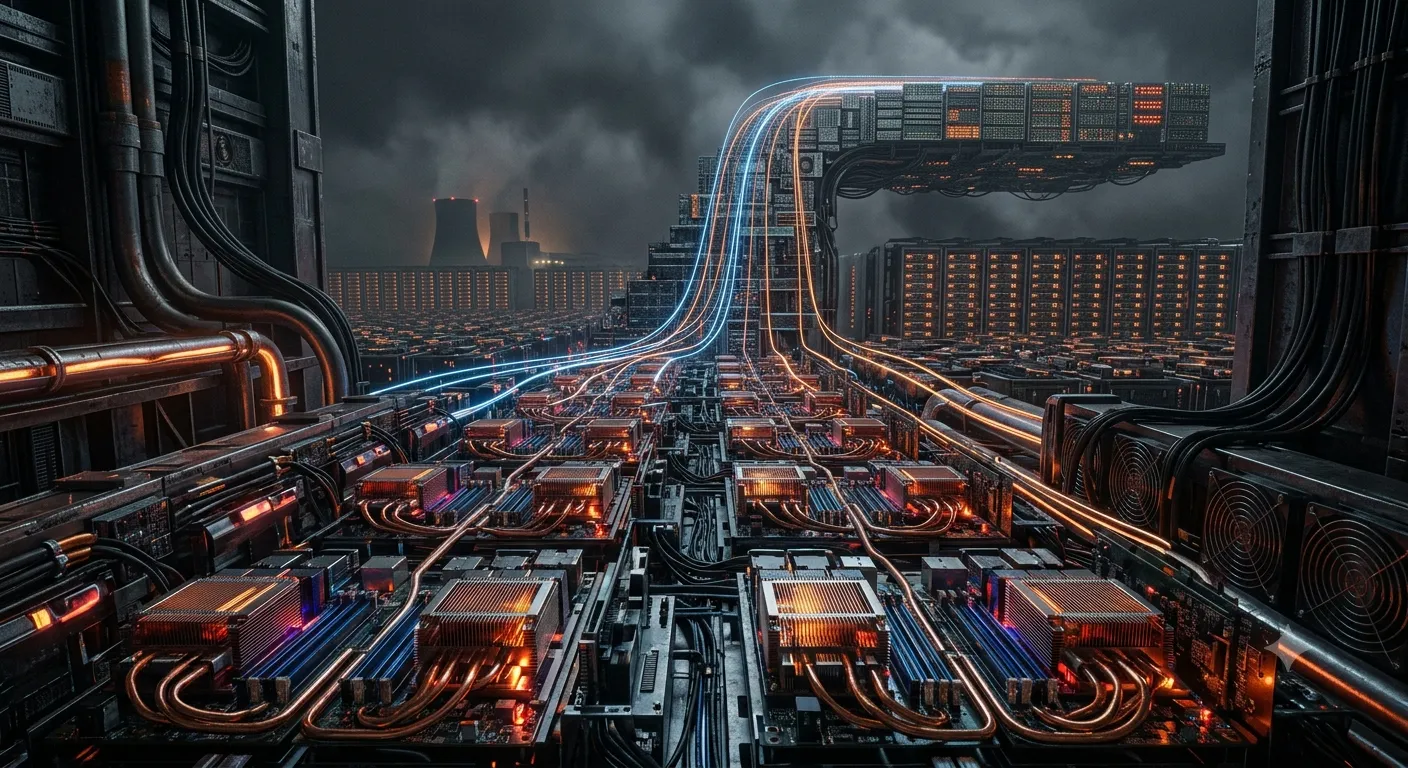
Building the physical backbone for AI is one of the most expensive projects in human history, with tech giants projected to spend up to $1 trillion on AI capital expenditures in the coming years.
Originally, the biggest expense was training—spending months running thousands of chips to build a model. Now, the cost has flipped to inference—the computing power used every single time a user asks the AI a question. When companies try to move large AI projects out of testing and into daily business operations, the sheer volume of continuous user queries causes server costs to spike aggressively.
3. The Hardware Problem: How Long Do GPUs Last?
The specialized graphics cards (GPUs) that power AI are under immense structural pressure. When building these systems, companies must look at two different lifespans:
- Physical Lifespan (3 to 5 Years): Running chips at 100% capacity 24/7 creates intense heat and structural stress. In real-world data shared by Meta during the training of their Llama 3 flagship model (Meta AI, 2024), the engineering team experienced 466 system interruptions over a 54-day period across their cluster of 16,384 Nvidia H100 GPUs. Roughly half of these disruptions were caused by physical failures in the GPUs or their specialized high-bandwidth memory.
- Economic Lifespan (2 to 3 Years): Long before the chip physically breaks, it becomes obsolete. Newer chip architectures enter the market so rapidly that older hardware becomes too slow and expensive to operate compared to new, energy-efficient replacements.
4. The Power Crisis: Feeding the Beast
AI servers consume vastly more electricity than traditional web servers. A single question asked to an advanced, reasoning AI model requires drastically more energy than a standard search engine query.
This sudden spike in demand is putting unprecedented strain on local power grids. In major tech hubs, the energy demand from data centers has grown so fast that companies are buying up stakes in nuclear power plants just to secure a dedicated, unshared source of electricity.
5. Output vs. Revenue: The Financial Reality
The biggest risk to the AI industry is the massive gap between the money spent and the revenue made. Companies are generating massive amounts of "output"—millions of lines of code, customer service responses, and documents. But turning that into corporate profits has proven incredibly difficult.
"Despite hundreds of billions spent on infrastructure, the technology has relatively little revenue to show for it so far... The crucial question is whether this spending will ultimately unlock low-cost, automated solutions or simply become a massive financial burden."
— Goldman Sachs Research, "Gen AI: Too Much Spend, Too Little Benefit?" (2024)
Tech analysts argue that AI technology is incredibly expensive, yet it is primarily being used to solve basic, low-value tasks like summarizing emails or writing basic code. To justify a trillion-dollar infrastructure bill, AI needs to solve incredibly complex, high-value problems—something current architectures are not yet equipped to do reliably.
Bottom Line: Refinement Over Raw Size
The AI industry isn't going to collapse, but it is undergoing a necessary reality check. The initial wild dream—that we could reach human-level AI simply by building infinitely larger data centers—has proven false. The future of AI will belong to efficiency: smarter, smaller models that don't drain the local power grid, and precise, industry-specific tools that actually save companies money.
Sources
- Acemoglu, D. (2024). The Simple Macroeconomics of AI. National Bureau of Economic Research (NBER Working Paper No. 32487).
- Epoch AI. (2022). Will We Run Out of Data? Limits of LLM Scaling Based on Human-Generated Text.
- Goldman Sachs Research. (2024). Gen AI: Too Much Spend, Too Little Benefit? Goldman Sachs Equity Research.
- Meta AI. (2024). The Llama 3 Herd of Models: Infrastructure and Hardware Resilience Report. Meta Engineering.